GHK-Cu beef tallow: what copper peptide tallow can and can't do
Why tallow and copper peptides got paired, what the research on GHK-Cu really shows, the chemistry catch most tallow balms miss, and what a seller can put on the label.
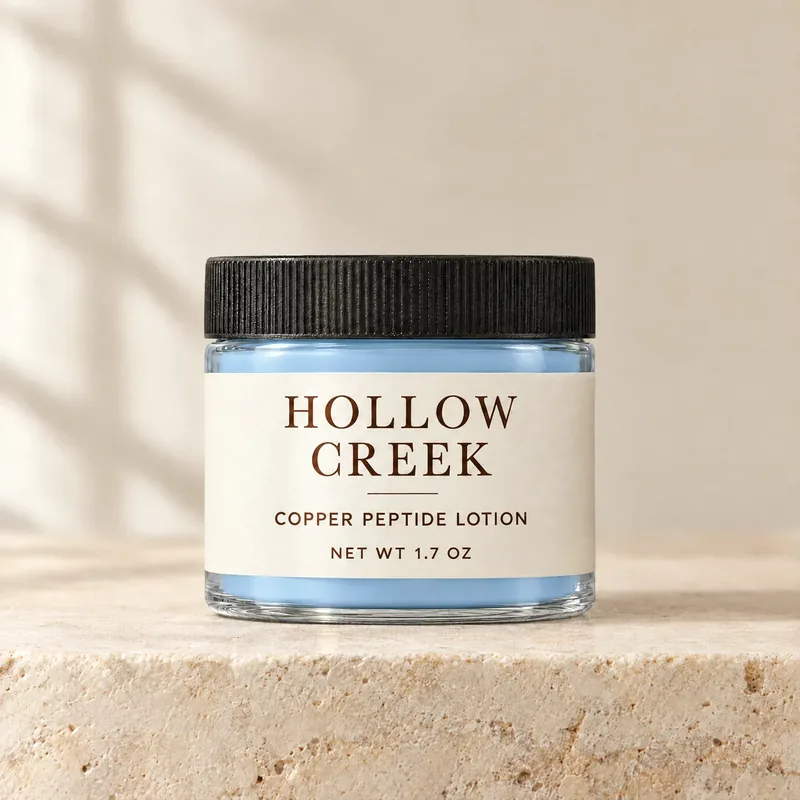
GHK-Cu beef tallow is beef tallow skincare with a copper peptide (copper tripeptide-1) added. The tallow does the moisturizing. The evidence for the copper peptide on skin is real but small and early. One catch matters more than any claim: GHK-Cu dissolves in water, not fat, so in a pure tallow balm with no water it can't dissolve. If you want both, look for a tallow lotion or cream with water near the top of the ingredient list and the GHK-Cu percentage stated, and patch test first.
What GHK-Cu beef tallow is
GHK-Cu is a tiny protein fragment, three amino acids long (glycine, histidine and lysine), holding a copper ion. On a cosmetic label it is listed as Copper Tripeptide-1. It occurs naturally in human blood. Loren Pickart reported it in 1973, and his own later reviews put blood levels at about 200 ng/mL at age 20 and about 80 ng/mL by age 60. That decline is the root of most of the marketing.
The copper is why the ingredient is blue. Copper complexes absorb orange-red light (the pure complex peaks at 600 nm in the safety dossier), so what reaches your eye looks blue. A copper peptide product that is blue has a visible amount of copper peptide in it. One that looks white may have very little.
Beef tallow is rendered beef fat, a rich moisturizer that sits on top of skin and slows water loss. Our beef tallow for skin guide grades every tallow claim. GHK-Cu beef tallow puts the two together, usually as a whipped balm, sometimes as a lotion or cream.
Why everyone is talking about it
Two trends met. Tallow skincare took off with the "ancestral" and seed-oil-free crowd. Then copper peptides became, in NPR's words, "the darling of social media skin care hacks", sold on TikTok and Instagram as "nature's Botox" and as a retinoid alternative. Pairing them was only a matter of time.
Here is what US Google searches show (monthly searches from Google Ads):
| Search | Oct 2025 | Jan 2026 | Apr 2026 | Jul 2026 | Sep 2026 |
|---|---|---|---|---|---|
| ghk cu beef tallow | 30 | 110 | 390 | 1,000 | 480 |
| ghk cu tallow | 0 | 140 | 140 | 260 | 210 |
| copper peptide lotion | 390 | 720 | 880 | 1,900 | 1,300 |
| copper peptide | 14,800 | 27,100 | 40,500 | 40,500 | 40,500 |
Google Trends tells the rest. US interest in "GHK-Cu" peaked in April 2026. By October it was about a fifth of that peak, but still above October 2025 and more than five times October 2024. Interest in "copper peptide" was nearly three times its level a year earlier. The hype has cooled, and the category has stayed.
Part of the spike had nothing to do with skincare. NPR reported that the trend "has gone from creams to injections", with people injecting gray-market GHK-Cu ahead of any human safety data. Everything in this guide is about products you put on your skin.
The catch: GHK-Cu dissolves in water, not fat
This is the part most GHK-Cu tallow balms skip. GHK-Cu is strongly water-loving. In a lab test that measures where a substance settles between an oily layer and a watery one, it settled about 250 to 300 times more in the water (log D of about −2.4 at skin-friendly pH). Supplier data sheets describe it simply as "water soluble". At least one ingredient supplier sells a separate, modified grade for oil-based formulas, which tells you the standard powder isn't made for them.
Beef tallow is almost pure fat, with essentially no water. Our reasoning from those facts: stir standard GHK-Cu powder into a water-free tallow balm and it cannot dissolve. At best it hangs in the fat as tiny undissolved specks. At worst it clumps or settles, so one scoop has more than the next. We found no published study of GHK-Cu in a water-free animal-fat base, for stability or for anything else.
There are honest ways to combine the two:
- An emulsion (a lotion or cream) has a water phase the peptide can dissolve in, with the tallow in the oil phase. It needs an emulsifier and a preservative, because anything with water can grow microbes.
- A purpose-built oil-friendly ingredient, such as a modified copper peptide grade made for oils. It is a different material, and the label should say what it is.
How to tell from the ingredient list. US cosmetic labels list ingredients from most to least. If water (or aqua) is near the top, you are looking at a lotion or cream. If the list is tallow, oils and wax with no water, it is a balm, and any GHK-Cu in it is suspended, not dissolved.
What is actually on the shelf. On November 6, 2026 we opened 46 Amazon listings for "ghk cu tallow". 23 showed an ingredient list, and 20 of those 23 had no water at all: water-free balms. Only 4 of the 46 stated how much GHK-Cu they contain. Several no-name listings copied another brand's ingredient list word for word.
| Format | Water in it? | Can standard GHK-Cu dissolve? | Needs a preservative? |
|---|---|---|---|
| Tallow balm | No | No; it sits as specks | Usually not |
| Whipped tallow balm | No (the air is whipped in) | No; it sits as specks | Usually not |
| Tallow lotion or cream | Yes, usually the first ingredient | Yes, in the water phase | Yes |
| Water-based serum | Yes | Yes | Yes |
If you sell tallow skincare: ask your maker in writing how the GHK-Cu is carried in the base, and get the ingredient list with percentages. "1% GHK-Cu" on a water-free balm is a number that tells your customer very little.
Claim by claim: what the evidence says
GHK-Cu has decades of lab research behind it, but much less on human skin than social media suggests. Reviews published in 2026 are cautious. One calls it "promising but unproven", one found only 2 randomized trials among 20 studies, and another found that about 35% of the published research includes the same two authors, whose work is tied to a company that sells copper peptides. Here are the claims you will see, graded:
- Established: well accepted by dermatologists.
- Early evidence: a few small human studies, not yet confirmed.
- Lab only: shown in cells or animals, not on human skin.
- Not supported: no good evidence, or the evidence points the other way.
| Claim | What the evidence says | Grade | What a brand may say |
|---|---|---|---|
| Moisturizes dry skin | That is the tallow (and any glycerin or oils), not the peptide. Rich fats slow water loss. | Established | "Moisturizes dry skin." "Leaves skin feeling soft." |
| Reduces wrinkles | The best positive trial gave 40 women a GHK-Cu serum in a special nano-carrier for 8 weeks and saw less wrinkle volume and depth than a control serum. The only full peer-reviewed trial with objective measures we could read (13 people after laser treatment) found no measurable difference. The most-quoted facial studies are 2002 conference abstracts with no published methods. | Early evidence | "Helps improve the appearance of fine lines" (with the word "appearance"). Never "reduces wrinkles". |
| Boosts collagen | Collagen effects come mostly from cell studies, at nanomolar amounts. The FDA treats products meant to increase collagen production as drugs. | Lab only | Nothing about collagen. "Skin looks smoother" if your own testing backs it. |
| "Resets 4,000 genes" | The figure comes from a database of gene activity in cultured cells, not from skin treated with a cream. | Not supported | Nothing about genes or DNA. |
| Better than retinol | The comparison traces back to one small 1998 pilot on thigh skin, published in a journal not indexed in PubMed. The American Academy of Dermatology worries patients drop proven retinoids for copper peptides. | Not supported | Nothing comparing it with retinol or tretinoin. |
| Gets deep into skin | One lab study of human skin found almost no peptide or copper passed through intact skin in 9 hours. A dermatologist told NPR it "doesn't easily penetrate deeper" on its own. | Not supported | Nothing about penetration or absorption depth. |
| Heals wounds and scars | GHK-Cu was once tested as a wound drug for diabetic foot ulcers. That is exactly why the claim is a drug claim. | Not for a cosmetic | Nothing about wounds, scars, acne or eczema. |
And none of the human studies above tested GHK-Cu in tallow. Results from a nano-carrier serum don't transfer to a balm, or to any other formula.
How much GHK-Cu is in it?
Products on the market run from well under 0.1% to 2% or more. The Ordinary's well-known serum is sold as "1%". Three things to know before you compare numbers:
- No study shows that more works better. We found no human trial comparing strengths. The lab effects show up at tiny amounts, and some reverse at higher doses.
- Ask "1% of what?" Some suppliers sell GHK-Cu already dissolved in water. One sells a 1,000 ppm solution with a recommended use of 2%, which works out to about 0.002% actual GHK-Cu. A label can truthfully say "2% copper peptide solution" and contain a thousand times less peptide than a pure 2%.
- The safety review was done at lower levels. The cosmetic industry's safety panel (CIR) judged copper tripeptide-1 safe "as used" when typical peptide use was under 10 parts per million. Today's 0.5% to 2% products are 500 to 2,000 times that.
What we saw in our own batches. When we developed our copper peptide tallow lotion, 0.05% and 0.1% GHK-Cu disappeared in the white lotion: no color at all. At 0.25% it turned faintly blue. Our lotion now uses 1%, a clear soft blue. The color is not proof of anything on skin, but a white "copper peptide" cream is worth a question.
What to look for in a GHK-Cu tallow product
- Water near the top of the list, if you want the peptide dissolved (see the catch above).
- The percentage stated, and whether it means pure GHK-Cu or a solution.
- A preservative, if there is water. A water-based product without one can grow mold and bacteria.
- A blue tint. A visible amount of copper peptide colors the product.
- No chelators in the same product. Supplier sheets warn that chelating agents such as disodium EDTA can't be formulated with it, because they pull the copper away.
- Grass-fed tallow, named, and a lot number and best-by date on the jar.
- No injection, dosing or "research use only" talk anywhere on the brand's site. That is a different, unapproved product category.
Side effects, and who should skip it
The American Academy of Dermatology notes that copper peptide users may develop redness, burning, irritation or dermatitis, particularly when products are combined, and recommends a patch test. A 2026 review adds that copper is a recognized contact sensitizer in some people.
- Acne-prone or oily skin: the tallow is the bigger risk, because it can clog pores.
- Sensitive or broken skin, or skin fresh from a peel or laser: skip it, or ask your dermatologist.
- A known copper or metal allergy: skip it.
- Using strong acids, vitamin C or retinoids: The Ordinary tells customers not to use its copper peptide serum in the same routine as direct acids, direct vitamin C or retinoids. That is brand guidance, not a study, but it is a sensible place to start.
"Copper uglies", skin looking duller or more lined after starting copper peptides, is an internet term with no clinical data behind it. If your skin gets worse, stop.
Is GHK-Cu legal?
On your skin, yes. Copper tripeptide-1 is a cosmetic ingredient, and US cosmetics need no FDA approval before sale. What makes a cosmetic a drug is what it claims: the FDA judges intended use from claims on the label, in ads and online.
Injecting it is a different matter. GHK-Cu is not an approved drug. The FDA flagged compounded injectable GHK-Cu as a possible immunogenicity risk with limited human data, and in 2026 it moved the substance between its compounding lists as nominations were withdrawn. It plans to ask its compounding advisory committee by February 2027. None of that governs a cream or balm, and no cosmetic should ever be injected.
For the full picture for brands (claims, warning letters and formulation), see the copper peptide skincare guide from Wholesale Tallow Soap USA, the team that makes TallowPal products.
Selling copper peptide tallow? What you can say
Copper peptide products get brands in trouble faster than plain tallow, because the trend talks in drug language. The FDA has cited "stimulates collagen growth", "reduces deep wrinkles" and "Natural Botox Alternative" in a warning letter to a peptide skincare brand, and calls collagen claims drug claims.
| The idea | Drug claim (avoid) | Cosmetic wording that fits |
|---|---|---|
| Lines | Reduces wrinkles, reverses aging | Helps improve the appearance of fine lines |
| Firmness | Boosts collagen and elastin | Skin looks smoother and feels soft |
| Renewal | Repairs, regenerates, heals | Moisturizes dry, tight-feeling skin |
| The ingredient | Natural Botox, resets your genes | Made with copper tripeptide-1 (GHK-Cu) |
| Proof | Clinically proven (without testing your formula) | Fragrance-free, made with grass-fed tallow |
Any "appearance" claim still needs support, and borrowed results from someone else's serum don't count. When in doubt, describe the ingredients and the feel.
The TallowPal option. Our Copper Peptide Tallow Lotion is the emulsion version: grass-fed tallow, jojoba oil and glycerin with 1% copper tripeptide-1 (GHK-Cu), dissolved in the water phase and preserved, fragrance-free, in a 2 oz clear glass jar. Its full list: Reverse-Osmosis Water, Grass-Fed Tallow, Jojoba Oil, Vegetable Glycerin, Emulsifying Wax, Stearic Acid, Optiphen, Vitamin E (Tocopherol), Copper Tripeptide-1 (GHK-Cu). It is $15.75 a unit with your label printed and applied, on the Brand plan. The Copper Peptide Serum (0.5% GHK-Cu, 2 fl oz, no tallow) is $18.00. The minimum is 1 unit, and each order ships under your brand within 2 business days, so you can dropship copper peptide skincare from Shopify, Etsy, TikTok Shop or Amazon without buying stock. Every label gets a claims check before it prints.
Sources
Read on November 6, 2026: NPR, The copper peptide trend has gone from creams to injections, ahead of the science (September 7, 2026); American Academy of Dermatology, Viral trends: copper peptides; Pickart and Margolina, Regenerative and Protective Actions of the GHK-Cu Peptide in the Light of the New Gene Data, Int J Mol Sci (2018); Pickart and others, GHK Peptide as a Natural Modulator of Multiple Cellular Pathways in Skin Regeneration, BioMed Res Int (2015); Badenhorst, Svirskis and Wu, Physicochemical characterization of native GHK-Cu, Pharm Dev Technol (2016); Badenhorst and others, Effects of GHK-Cu on MMP and TIMP expression, collagen and elastin production, and facial wrinkle parameters, J Aging Sci (2016); Miller and others, Effects of topical copper tripeptide complex on CO2 laser-resurfaced skin, Arch Facial Plast Surg (2006); Li and others, microneedle delivery of GHK-Cu, Pharm Res (2015); Najafi and others, systematic review of GHK-Cu (2026); Mateescu and others, GHK-Cu evidence map, Pharmaceutics (2026); Mokhtar and others, systematic review, Aesthet Surg J (2026); Mulder and others, GHK-Cu gel for diabetic foot ulcers, Wound Repair Regen (1994); Cosmetic Ingredient Review, Safety Assessment of Tripeptide-1, Hexapeptide-12, Their Metal Salts and Fatty Acyl Derivatives; Mobel Biomaterials, Copper Tripeptide-1 technical data sheet; The Ordinary, Multi-Peptide + Copper Peptides 1%; FDA, Wrinkle Treatments and Other Anti-aging Products, Is It a Cosmetic, a Drug, or Both? and Certain Bulk Drug Substances for Use in Compounding that May Present Significant Safety Risks, the 503A bulk substances list (updated May 14, 2026) and a 2017 warning letter to Star Health & Beauty. Search data: Google Ads monthly search volume and Google Trends, United States, pulled November 6, 2026.
This guide is general information, not medical advice. For a skin condition, a reaction, or before using a new active on sensitive or treated skin, ask a dermatologist.
Questions
Does GHK-Cu work in beef tallow?
GHK-Cu dissolves in water, not fat, so in a pure tallow balm with no water it stays undissolved. In a tallow lotion or cream it can dissolve in the water phase. No study has tested GHK-Cu in tallow either way, so any claim about how well it works in tallow is unproven.
Can you add copper peptides to tallow balm?
You can stir the powder in, but it will not dissolve in the fat and may clump or settle unevenly. To combine them properly you need an emulsion (water, an emulsifier and a preservative) or a copper peptide ingredient made for oils.
Is copper peptide tallow safe?
Topical copper tripeptide-1 is a long-used cosmetic ingredient, but it can cause redness, burning or irritation in some people, especially combined with other actives, and tallow can clog pores. Patch test for a day or two first, and skip it on broken or freshly treated skin.
Why is my GHK-Cu tallow blue or green?
The copper in GHK-Cu absorbs orange-red light, so it looks blue. Mixed with the yellow of tallow, a product can look blue-green. No color at all usually means very little copper peptide.
Can I use copper peptide tallow with retinol or vitamin C?
Copper peptide makers commonly advise keeping it apart from direct vitamin C, strong acids and retinoids, for example by using them at different times of day. That advice comes from brands and supplier sheets rather than studies.
Can I sell or dropship GHK-Cu tallow under my own brand?
Yes. TallowPal makes a copper peptide tallow lotion and a copper peptide serum and ships each order under your label, with no minimum order. Keep the claims cosmetic: appearance and feel, never collagen, healing or wrinkle removal.
General information, not legal or tax advice. Rules change, so check the current requirements for your state and sales channels.
Start with one jar.
Free to design. Pick a plan when you are ready to sell. No minimums, ever.